
Quick answer
Harvey is for legal work product. Lexi is for law firm operations.
Harvey is best understood as a legal intelligence platform for drafting, research, review, due diligence, and knowledge workflows. Lexi is the operational layer that helps a firm respond to clients, coordinate intake, schedule next steps, and move matters through the practice.
- Choose Harvey when the primary bottleneck is producing or reviewing legal work at enterprise scale.
- Choose Lexi when the bottleneck is intake speed, client follow-up, workflow coordination, and administrative execution.
- Use both if your firm wants legal AI for work product and a separate operating layer for the business of running matters.
This guide is written for law firm buyers comparing operational fit as of May 2026. Lexi is our product, so the recommendation is explicit about where Lexi fits, where another tool may be the better answer, and which workflow problem should drive the decision.
Harvey and Lexi solve different problems inside a law firm.
Harvey is designed for legal work product:
- drafting
- research
- review
- due diligence
- legal workflows
Lexi is designed for running the operational side of the practice:
- intake
- scheduling
- client communication
- follow-up
- workflow coordination
- administrative execution
Many firms evaluating AI for law firms are comparing both platforms because they sit on different layers of the stack.
What Harvey Is
Harvey is an enterprise legal AI platform built for legal teams and law firms.
Its platform focuses on:
- legal research
- drafting assistance
- document analysis
- due diligence
- knowledge systems
- workflow agents
- enterprise integrations
Harvey is particularly strong for:
- large document sets
- transactional review
- internal legal workflows
- enterprise legal operations
For firms handling complex legal work at scale, those capabilities can create meaningful efficiency gains. Harvey helps legal teams produce work faster.
What Lexi Is
Lexi is an AI operations platform for law firms.
It handles the work around legal work:
- intake
- scheduling
- follow-up
- workflow movement
- client communication
- administrative coordination
Instead of replacing legal judgment, Lexi reduces the operational burden around practicing law.
Lexi replaces fragmented systems firms still rely on:
- email chains
- intake forms
- spreadsheets
- disconnected calendars
- manual reminders
- repetitive administrative tasks
The goal is operational leverage. Not more software.
What Lexi Replaces
Most firms already have tools for legal drafting and research.
The bigger operational problem is usually:
- missed calls
- slow response times
- inconsistent intake
- delayed follow-up
- administrative overload
- fragmented communication
That operational friction affects:
- client conversion
- responsiveness
- staff workload
- firm efficiency
- client experience
Lexi is designed to reduce that friction.
Built Around Existing Law Firm Workflows
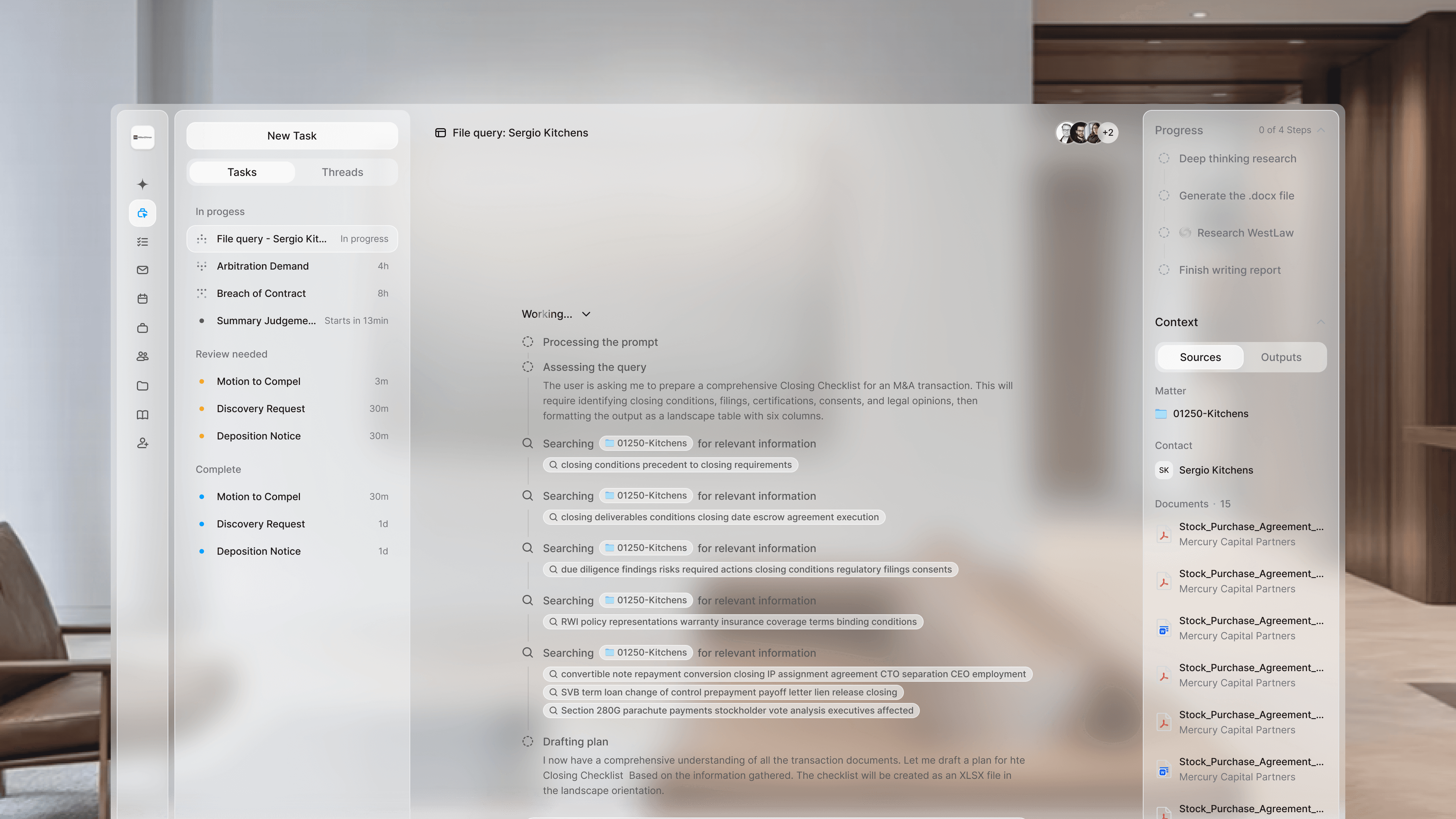
Lexi OS coordinating intake, tasks, client follow-up, and matter movement around tools like Clio, Westlaw, Slack, and Teams.
Lexi works inside the systems firms already use:
- Clio
- Westlaw
- Slack
- Microsoft Teams
The goal is not forcing firms to replace their practice infrastructure. The goal is creating a cleaner operational layer around it.
AI for Legal Work vs AI for Law Firm Operations
| Question | Harvey | Lexi |
|---|---|---|
| Primary job | Legal intelligence for drafting, research, review, and diligence | Run the operational work around the legal work |
| Best for | Legal work product and large-scale document analysis | Intake, communication, follow-up, workflow movement, and administrative execution |
| System layer | Knowledge, document, and legal workflow layer | Operational execution layer that connects existing tools |
| Firm outcome | Better or faster legal output | Faster response, cleaner intake, less administrative drag, and more consistent client experience |
This is the distinction many firms are now realizing. Legal AI tools help generate legal output.
Operational AI tools help firms:
- respond faster
- onboard clients faster
- coordinate work faster
- reduce administrative burden
- move matters through the firm more efficiently
Those are different categories. Harvey focuses on legal intelligence. Lexi focuses on law firm operations.
Can Firms Use Both?
Yes.
Many firms will ultimately use:
- legal AI tools for drafting, review, and research
- operational AI systems for intake, communication, and workflow execution
The platforms are not direct substitutes. They solve different operational problems.
Who Harvey Is Best For
Harvey is best for firms looking to improve:
- legal drafting
- due diligence
- document review
- enterprise legal workflows
- internal legal knowledge systems
Especially:
- AmLaw firms
- enterprise legal departments
- large transactional teams
- firms managing large-scale legal review
Who Lexi Is Best For
Lexi is best for firms trying to reduce:
- intake bottlenecks
- administrative overhead
- scheduling friction
- communication delays
- workflow fragmentation
Especially:
- growing law firms
- firms scaling client volume
- firms handling high inquiry volume
- firms trying to improve responsiveness and operational efficiency
The Operational Layer Is Becoming Strategic
Most firms do not lose clients because of legal skill.
They lose clients because:
- response times are slow
- intake breaks down
- communication feels fragmented
- operational systems are inconsistent
That layer shapes the client experience. Increasingly, it shapes growth.
FAQ
Is Harvey or Lexi better for a law firm?
Harvey is a better fit when the firm needs legal work product support such as drafting, research, review, and diligence. Lexi is a better fit when the firm needs to improve intake, scheduling, follow-up, client communication, and operational consistency.
Does Lexi replace Harvey?
No. Lexi and Harvey solve different problems. Harvey helps legal teams produce work faster, while Lexi helps the firm move work through the practice more reliably.
Which platform should a growing law firm evaluate first?
If missed leads, slow response times, and admin overload are the urgent problem, evaluate Lexi first. If document review, drafting, or legal knowledge workflows are the urgent problem, evaluate Harvey first.
Can Harvey and Lexi work in the same firm?
Yes. A firm can use Harvey for legal output and Lexi for intake, communication, scheduling, and workflow movement around that output.
Harvey is building AI for legal work. Lexi is building AI for running the modern law firm.